





In most factories the building simply houses the process. In a biopharmaceutical facility the building is part of the process. The air a sterile drug is exposed to, the pressure relationships between rooms, the surfaces an operator touches and the path a vial takes from formulation to fill — all of it determines whether the product is safe, and all of it is regulated. Environmental control is therefore not a finishing trade applied at the end of a build; it is the central engineering problem of the whole facility, and the part that most often decides whether a project passes regulatory inspection on schedule.
This article examines the environmental-control challenges that biopharmaceutical companies repeatedly run into when designing, building and qualifying compliant production space: how cleanrooms are classified and certified, how air cleanliness is achieved and held, how zonal pressure differentials protect the product, and the specific difficulties that biologics, aseptic processing and multi-product operations add on top. The aim is practical — to show where the hard problems actually sit, and why getting the design right early is far cheaper than discovering it during qualification.

01 — The core problem
Why environmental control is the hardest part of a GMP build
A conventional industrial building can tolerate approximations: a few degrees of temperature drift, a draught, a scuffed wall. A GMP cleanroom cannot. Its performance is defined by numbers that must be demonstrated, documented and held continuously — particle concentrations, pressure differentials, air-change rates, recovery times, temperature, humidity and microbial counts — and every one of those numbers is a potential point of failure that an inspector can ask about.
Three features make this uniquely difficult. First, the requirements are interdependent: raising an air-change rate to improve recovery changes the room's pressure balance, which affects the door-opening behaviour of an adjacent airlock, which affects the cleanliness of the room next door. Nothing can be optimised in isolation. Second, the standard is continuous, not a one-off test — a facility that classifies beautifully on handover still has to stay in specification through years of people, materials and cleaning cycles passing through it. Third, the consequences of getting it wrong are regulatory and commercial at once: a contamination event or a failed qualification can halt production, trigger a recall, and delay a product's route to patients.
Because of this, environmental control has to be designed as a single integrated system from the first concept sketch. The regulatory framework now says so explicitly, and it is where any serious analysis has to begin.
02 — The framework
The regulatory landscape and the Contamination Control Strategy
Three reference frameworks govern the air in a pharmaceutical cleanroom, and they do different jobs. ISO 14644 is the international technical standard: it defines the cleanliness classes by particle concentration and prescribes how to measure and certify them. EU GMP Annex 1 — substantially revised in 2022 — sets the regulatory expectations for sterile manufacturing, adding microbial limits, occupancy-state distinctions and operational controls on top of the ISO particle classes. In the United States the FDA's aseptic-processing guidance covers similar ground with its own conventions. Most exporters must satisfy more than one of these at once.
The most consequential change in the 2022 Annex 1 is conceptual: it makes a documented Contamination Control Strategy (CCS) the organising principle of the whole facility. Rather than treating filters, gowning, cleaning, airflow and monitoring as separate boxes to tick, the CCS requires the manufacturer to show how all of these elements work together to control contamination, justified by quality risk management. In practice this raises the bar for design: every environmental-control decision now has to be traceable to a risk rationale and defensible as part of a coherent whole.
Annex 1's CCS is deliberately broad: it expects the manufacturer to consider, and link together, facility and equipment design, utilities, personnel and gowning, raw-material and component controls, process and cleaning, environmental and process monitoring, and the trending of all of it — around twenty elements in total. The practical effect is that an environmental-control decision can no longer be defended on its own; it has to be shown to fit the wider strategy. The same logic increasingly shapes FDA-regulated sites, and the broad international alignment of ISO 14644, EU GMP and PIC/S means a facility designed properly for one major market is usually designing for all of them at once.
For the facility engineer, the framework translates into four tightly linked questions that the rest of this article addresses in turn: what cleanliness class does each space need and how is it certified; how is that air cleanliness produced and maintained; how are the pressure relationships between spaces controlled; and how is the whole thing qualified and kept in compliance.
03 — Classification & certification
Cleanliness classes: what must be certified, and how
Every cleanroom space is assigned a target cleanliness level. Under ISO 14644-1 the scale runs from ISO Class 1 (cleanest) to ISO Class 9, each step allowing roughly ten times more airborne particles than the one below. EU GMP Annex 1 layers its own Grades A, B, C and D over this for sterile manufacturing, where the grade describes not just a particle count but a process-risk zone with its own gowning, monitoring and airflow expectations.
The single most important — and most misunderstood — feature of pharmaceutical classification is that each grade is verified in two occupancy states. "At rest" means the room is complete with equipment running but no personnel present; it is effectively an installation check. "In operation" means the process is running with the full complement of operators defined in the procedures — the real stress test, because people are by far the largest particle source in any cleanroom. A room can pass at rest and fail in operation, which is exactly the gap that surprises teams who designed to the wrong state.
| GMP grade | Typical use | ISO equivalent — at rest | ISO — in operation | Max ≥0.5 µm/m³ (at rest → in operation) |
|---|---|---|---|---|
| Grade A | Critical zone: aseptic filling, open product handling | ISO 5 | ISO 5 | 3,520 → 3,520 |
| Grade B | Background to Grade A for aseptic preparation/filling | ISO 5 | ISO 7 | 3,520 → 352,000 |
| Grade C | Less critical preparation stages | ISO 7 | ISO 8 | 352,000 → 3,520,000 |
| Grade D | Support areas, lower-risk steps | ISO 8 | risk-based* | 3,520,000 → risk-based* |
*For Grade D, Annex 1 does not predetermine an in-operation limit; the manufacturer sets it from a risk assessment and routine data. The historic Federal Standard 209E term "Class 100" corresponds to today's ISO Class 5 — i.e. a Grade A/B air-cleanliness level — which is why "class 100 clean room" and "ISO 5" are used interchangeably in practice.
It is not only particles: microbial limits
For sterile manufacturing a grade is defined by viable (microbial) limits as well as particle counts, and these are what environmental monitoring chiefly tracks in operation. Annex 1 gives recommended limits across four methods — active air sampling, settle plates, contact plates and operator glove prints — and they tighten sharply with the grade. The defining change in the 2022 revision is that Grade A is effectively zero: the expected result is no growth, and any single colony recovered is treated as a deviation requiring investigation.
| Grade | Active air (CFU/m³) | Settle plate Ø90 mm (CFU / 4 h) | Contact plate Ø55 mm (CFU) | Glove print, 5 fingers (CFU) |
|---|---|---|---|---|
| A | No growth — any recovery (≥1 CFU) investigated | No growth | No growth | No growth |
| B | 10 | 5 | 5 | 5 |
| C | 100 | 50 | 25 | — |
| D | 200 | 100 | 50 | — |
Classification, qualification and monitoring are not the same thing
A great deal of confusion — and many compliance gaps — come from blurring three distinct activities. Classification is the specific particle-counting test that proves a room meets its ISO class, performed to defined sampling-location and air-volume rules. Qualification is the broader exercise of demonstrating the room is fit for use — design, installation and operational qualification (DQ/IQ/OQ), of which classification is only one input. Monitoring is the ongoing, routine measurement during production that shows the room stays in control. A facility can be perfectly classified yet poorly monitored, and it is the monitoring record, not the handover certificate, that an inspector scrutinises. Treating cleanroom certification as a one-time event rather than a lifecycle is one of the most common — and most expensive — mistakes in compliant construction.
The certification itself carries practical traps: the number and position of sampling points scale with room area and must be justified; the occupancy state must match the claim; and the result is only valid against a clearly defined class for that specific space. Getting the classification scheme wrong on paper guarantees rework in the field.
Certification is also tied to defined occupancy states: most grades must be demonstrated both “at rest” and “in operation,” and a room that passes empty can still fail when it is full of working operators. A further acceptance criterion is the clean-up (recovery) time — how quickly a space returns to its class after a disturbance, conventionally on the order of 15–20 minutes for a well-designed room. Annex 1 has also made the historic ≥5 µm particle limit optional for the cleanest grades while tightening expectations elsewhere, so the precise limits a project must certify against follow the current standard rather than older rules of thumb.
04 — Air cleanliness & HVAC
Producing — and holding — the air cleanliness requirement
Hitting a particle class is an exercise in moving very large volumes of highly filtered air in a controlled way. The cleaner the class, the more air, the more filtration and the more carefully it has to be delivered.
Filtration and airflow pattern
Final filtration is by HEPA filters — and, for the most critical work, ULPA filters that capture an even higher fraction of the finest particles. But the filter is only half the story; how the filtered air is delivered defines the grade. The critical Grade A zone requires unidirectional airflow — a smooth, even sweep of air, conventionally around 0.45 m/s at the working position — that continually washes particles away from the exposed product. Lower grades (B, C, D backgrounds) typically use turbulent (non-unidirectional) airflow that dilutes and removes contamination through a high air-change rate: dozens of room-air changes per hour, with the exact rate set by the class, the heat and particle load, and the required recovery performance rather than by a single fixed number.
Recovery, integrity and visualisation
Three tests turn "clean on paper" into "clean in practice", and each is a place projects stumble. Recovery measures how quickly a room returns to its cleanliness class after a disturbance; too low an air-change rate fails it. Filter integrity testing (an aerosol challenge such as PAO/DOP) proves the installed HEPA/ULPA filters and their seals have no leaks — a single bypass at a filter gasket can quietly defeat an entire room. And airflow visualisation — the smoke study now explicitly expected for Grade A under Annex 1 — provides filmed evidence that air actually sweeps the critical zone the way the design intended, with no turbulence or dead spots over the open product. Smoke studies routinely reveal that real equipment, operators and trolleys disturb airflow in ways the drawings never showed.
Temperature, humidity and fresh air
Air cleanliness is not only about particles. The same HVAC system has to hold temperature and relative humidity inside defined limits — for product stability, for process steps such as lyophilisation or coating, and for the comfort of fully gowned operators, whose particle shedding rises sharply when they are too warm. It must also introduce enough fresh make-up air to offset what is exhausted at airlocks, biosafety cabinets and isolators while still maintaining every pressure differential, which is why so much installed plant capacity goes into conditioning and moving air that is then largely recirculated through the final filters. How all of this is measured — classification, recovery, filter integrity and airflow, and how often each must be re-confirmed — is codified in ISO 14644-2 and ISO 14644-3, the standards a qualification plan is built around.
The underlying tension in this section is between cleanliness, energy and stability. More air gives better recovery and margin but costs energy and can create turbulence; less air saves money but erodes the safety margin. Resolving that trade-off correctly, class by class and room by room, is core HVAC design work — and it depends entirely on the surfaces and pressure scheme described next.
05 — Zonal pressure differentials
Pressure cascades: keeping contamination from crossing the line
If air cleanliness is what keeps a single room clean, pressure differential is what stops a dirty room from contaminating a clean one. The governing idea is the pressure cascade: each cleaner space is held at a higher pressure than the less-clean space beside it, so that whenever a door opens or a gap exists, air flows out of the cleaner room rather than into it. A typical step between adjacent classified grades is on the order of 10–15 Pa, with monitored differentials and alarms on the critical boundaries.
A pressure cascade between GMP grades
Each cleaner zone sits at higher pressure; air always flows from the cleaner room toward the less-clean one.
Airlocks: where the cascade is won or lost
The cascade is enforced at the transitions, and those transitions are airlocks — separate small rooms that buffer one grade from the next for people (personnel airlocks, PAL) and for materials (material airlocks, MAL). Airlocks come in three pressure archetypes, and choosing the wrong one is a classic design error:
- Cascade airlock. Pressure steps down progressively from the clean side to the dirty side; the airlock sits at an intermediate pressure. The common choice between adjacent grades.
- Bubble airlock. The airlock is held at higher pressure than both rooms it joins, so air pushes out into both — used to keep two clean areas from cross-contaminating.
- Sink (or "cascade-down") airlock. The airlock is held at lower pressure than both neighbours, so air is drawn in from both — used to contain a hazardous or live-organism area.
Maintaining these differentials in the real world is harder than the schematic suggests. Every door opening is a transient that momentarily collapses the differential; interlocked doors (only one open at a time) are therefore mandatory on critical airlocks, and the control system has to ride through the transient without nuisance alarms or pressure reversals. Room envelope integrity matters just as much: a leaky panel joint, an unsealed cable penetration or a poorly gasketed door bleeds pressure and forces the HVAC to chase a target it can never quite hold. This is precisely where construction quality and HVAC design meet — and where they most often fail together.

06 — Biopharma-specific difficulty
What biologics and aseptic processing add on top
Everything above applies to sterile manufacturing generally. Biopharmaceuticals — vaccines, monoclonal antibodies, cell and gene therapies — add a further layer of difficulty, because they combine the strictest cleanliness demands with requirements that can directly conflict with them.
Aseptic processing: barriers and people
Where a product cannot be terminally sterilised — true of most biologics — it must be made by aseptic processing, and human operators are the dominant contamination risk. The modern answer is to engineer people out of the critical zone with barrier technology: RABS (restricted access barrier systems) and, increasingly, isolators that fully separate the Grade A zone from the operator. These sharpen the environmental-control problem rather than removing it — an isolator still needs defined airflow, leak-tightness, and a bio-decontamination cycle (typically vaporised hydrogen peroxide) whose residues must clear before production. Personnel and material flows must be strictly unidirectional, with gowning and de-gowning sequenced through airlocks so that clean and used paths never cross.
Single-use (disposable) systems have become a major contamination-control lever in biologics. Replacing cleaned-and-sterilised stainless steel with pre-sterilised single-use bags, tubing and assemblies removes whole cleaning- and sterilisation-validation burdens and closes the process against the room — but it shifts the problem rather than erasing it. Connections must still be made aseptically or through validated sterile connectors; supplier quality, extractables and leachables become part of the contamination control strategy; and the supporting room grade still has to be justified. The wider move toward closed and functionally-closed processing can lower a background grade by a step, but only where the closure itself is demonstrated rather than assumed.


The cleanliness-versus-containment conflict
The hardest design tension in biopharma is that product protection and operator/environmental protection can demand opposite pressure regimes. Clean processing wants the critical zone at positive pressure to keep contamination out. But when the process handles live organisms, viral vectors or highly potent compounds, biosafety wants the same zone at negative pressure to keep the hazard in. Reconciling the two — often with a positive-pressure product zone nested inside a negative-pressure containment shell, linked by carefully designed sink airlocks — is among the most demanding problems in facility design, and one with no generic answer: it has to be solved per process, documented in the CCS, and proven in qualification.
Multi-product facilities and cross-contamination
Few biopharma sites make only one product. As soon as a facility is multi-product, cross-contamination control becomes a design driver: dedicated or carefully segregated air-handling, pressure regimes that prevent migration between suites, unidirectional material and waste flows, and cleaning/changeover regimes that are themselves validated. The flexibility to reconfigure suites as a product pipeline evolves — without compromising any of this — is a recurring requirement, and one reason prefabricated, reconfigurable construction has become attractive for pharma clean rooms.
07 — Qualification & ongoing control
Proving it once, and proving it every day
A compliant facility has to clear two hurdles that are easy to conflate: a one-time qualification at handover and a continuous demonstration of control thereafter.
Commissioning, qualification and validation (CQV) walks a structured path — design qualification confirms the design meets the requirements; installation and operational qualification confirm the systems are built and run as specified; and performance qualification, including particle classification, recovery, filter-integrity and airflow-visualisation testing, confirms the room performs. For sterile processes this culminates in aseptic process simulations ("media fills"), in which the process is run with growth medium in place of product to demonstrate that the whole environment-plus-procedure system can produce sterile output.
Then the harder, quieter discipline begins: routine environmental monitoring. Non-viable particle counts, viable air and surface sampling (settle plates, active air samplers, contact plates), and continuous monitoring of pressure, temperature and humidity all feed a trending programme whose job is to catch drift before it becomes an excursion. Annex 1's emphasis on data trending means it is no longer enough to be in limits on any given day; a facility must show it understands and controls its environment over time. Continuous environmental monitoring systems that log particle counts, differential pressures and conditions are now effectively expected, and the gap between a room that was certified once and a room that is demonstrably in control every shift is where many sites are found wanting.
Increasingly, that continuous demonstration is judged as much on data integrity as on the readings themselves. Monitoring and building-management systems have to produce records that are attributable, legible, contemporaneous, original and accurate — the ALCOA+ principles — with secure audit trails, controlled access, and alarms that cannot be silently overridden. Under EU GMP Annex 11 and equivalent expectations for computerised systems, a pressure or particle excursion that is not captured, time-stamped and explained is treated as a loss of control even if the physical room never actually drifted. Building this in from the start — qualified instruments, validated software, and defined alarm-response procedures — is far cheaper than retrofitting it after an inspection finding.
The handover certificate proves a cleanroom can meet its class. The monitoring record proves it does. Regulators care far more about the second.
08 — Surfaces & construction
Where compliant construction is won: surfaces and the build itself
Much of whether a facility holds its grade is decided not by the HVAC schematic but by the physical envelope — the surfaces, joints and details that either support contamination control or quietly undermine it.
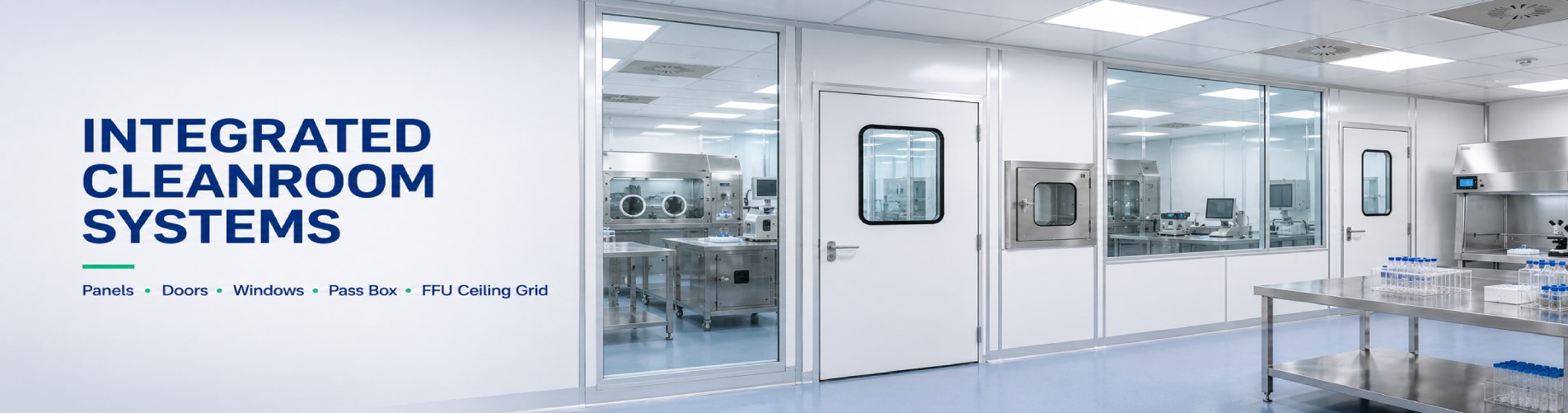
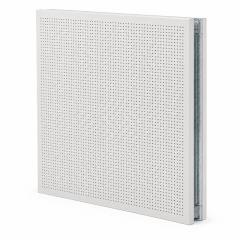
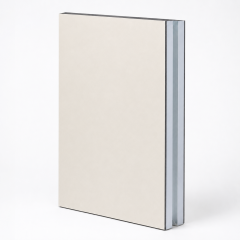
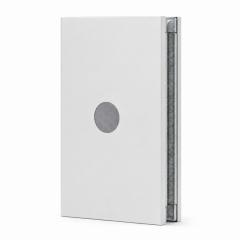
Every interior surface in a classified space has to be smooth, non-shedding, non-porous and chemically resistant, able to withstand repeated aggressive disinfection (including sporicidal agents and, in isolators, vaporised hydrogen peroxide) without degrading. Junctions are coved rather than square so there are no particle-trapping corners; wall, ceiling and floor systems are flush and fully sealed; penetrations for pipes, cables and ducts are sealed to preserve both cleanliness and pressure integrity. This is why prefabricated cleanroom systems built from HPL and metal sandwich panels with sealed, gasketed joints, flush doors and double-glazed vision panels have become the default for GMP work: the hard, cleanable surface and the controlled joint are exactly what the regulation rewards.
The construction method has itself become a way to de-risk compliance. Building the envelope as prefabricated modules means the dust-generating cutting and finishing happens in a factory rather than inside the future clean space, quality is consistent and documented, and assembly on site is faster and cleaner — all of which streamlines qualification. Because modular envelopes bolt together from standard, gasketed components, suites can later be reconfigured or expanded as a product pipeline changes, without demolishing a qualified environment — a direct answer to the multi-product flexibility problem raised earlier. For many biopharma projects, this is why modular cleanroom construction is now weighed on equal terms with traditional stick-built methods.


09 — Common failure modes
Where compliant biopharma projects most often go wrong
The difficulties described above tend to surface as a small, recurring set of failures. They are rarely exotic engineering problems; far more often they are ordinary decisions taken too late, sequenced wrongly, or validated too lightly. Naming them helps, because each is comparatively cheap to prevent at design stage and painfully expensive to correct once concrete and ductwork are in place.
- Designing for “at rest” and discovering “in operation.” Rooms that classify beautifully when empty fail once people, equipment heat load and movement are present — the only state regulators ultimately care about.
- Pressure cascades that look right on the schematic but collapse in use. Doors interlocked incorrectly, the wrong airlock type at a critical boundary, or an envelope too leaky to hold the differential — the cascade is only as good as its weakest opening.
- Filter and seal leaks that defeat a clean room invisibly. A single bypass at a HEPA gasket, found only at integrity testing, can negate the entire installed filtration of a suite.
- Airflow the drawings never tested. Smoke studies repeatedly reveal real equipment and operators creating turbulence and dead zones over open product that no static layout predicted.
- Cleanliness-versus-containment left unresolved. Live-organism and high-potency processes whose pressure regime is settled in the field, rather than designed and documented in the CCS, create both compliance and safety exposure.
- Surfaces and penetrations that cannot really be cleaned. Square junctions, unsealed service penetrations and finishes that degrade under sporicidal agents quietly undermine the grade the HVAC works so hard to deliver.
- Monitoring and data integrity bolted on at the end. A facility that passes a one-time classification but cannot show trended, tamper-evident control every shift is the single most common gap inspectors find.
None of these is a failure of ambition; they are failures of sequencing — of treating environmental control as something to be confirmed at the end rather than designed, built and proven from the first line on the drawing. The projects that run smoothly are the ones that fix the cleanliness and pressure scheme on paper, choose surfaces and an envelope that can hold it, and plan monitoring and qualification before, not after, the build.
De-risking environmental control — a practical checklist
- Design to "in operation," not "at rest." Size air changes, recovery and pressure for the room full of working people, since that is the state that fails.
- Fix the cleanliness scheme on paper first. Assign each space an ISO class and GMP grade, and define sampling and occupancy states before construction, not during qualification.
- Treat the pressure cascade as a system. Choose the right airlock type at every boundary, interlock critical doors, monitor and alarm the key differentials, and seal the envelope so it can hold them.
- Resolve cleanliness-versus-containment explicitly for any live-organism or high-potency process, and document the rationale in the contamination control strategy.
- Plan monitoring and trending from day one. A facility is judged on staying in control, not on a single classification certificate.
- Let the envelope do its share. Specify cleanable, disinfectant-resistant, flush, sealed surfaces, and use prefabricated construction to make quality consistent and the facility reconfigurable.
Planning a GMP cleanroom or biopharma suite?
Share your target grades, layout and timeline. Wonclean's engineers can help translate ISO and GMP requirements into a buildable design — prefabricated panels, FFU ceilings, airlocks, pass boxes and sealed envelopes that classify cleanly and stay in control.
FAQ
Frequently asked questions
What is the difference between an ISO class and a GMP grade?
What does "Class 100" mean, and how does it relate to ISO 5?
Why are cleanrooms certified both "at rest" and "in operation"?
What pressure differential is used between cleanroom grades?
Can modular (prefabricated) cleanrooms meet GMP requirements?
This article is a technical overview for orientation; classification limits and mappings follow EU GMP Annex 1 (2022) and ISO 14644-1:2015, but the correct design, cleanliness target and contamination control strategy for any specific facility must be confirmed by qualified cleanroom and quality professionals. Project and product references describe Wonclean Technology Company Limited's own work and offerings.


 온라인 서비스

